Why 90% of Retail Traders Lose Money in Indian Markets: SEBI Study Breakdown & Reality Check (2026)
💡 Quick Takeaways: The Unfiltered Reality of Retail Trading in India
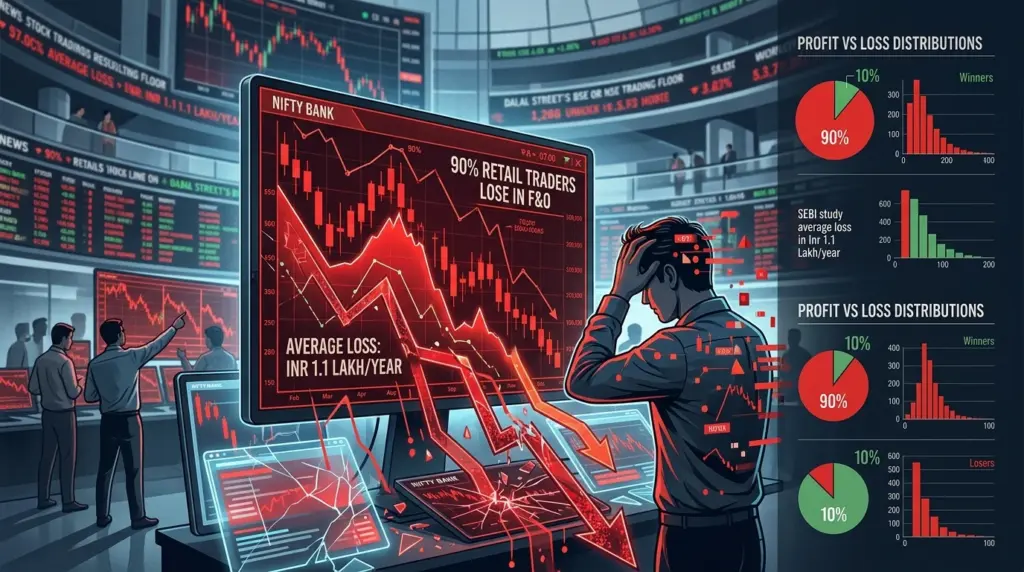
- 93% Incur Net Losses: The official SEBI study covering FY22 through FY24 revealed that a staggering 93% of individual retail traders in the Equity Derivatives (F&O) segment suffered net losses.
- ₹1.81 Lakh Crore Wealth Destroyed: Over a 3-year period, individual traders collectively incinerated over ₹1.81 Lakh Crore (over $21 Billion) in net trading losses in Indian stock markets.
- Average Loss of ₹1.25 Lakh per Trader: The average loss per loss-making trader stood at ₹1.25 Lakh (including transaction costs). The top 3.5% of loss-makers lost an average of ₹28 Lakh each!
- Hidden Friction Bleed: Even among the ~7% who generated a gross profit, over 50% of their nominal trading gains were completely wiped out by transaction costs (brokerage, STT, exchange turnover fees, and GST).
- The Professional Solution: Trading is not a hobby or an app-gamified lottery—it is a rigorous business requiring statistical edge, strict 1% risk management, and disciplined mentorship. Meanwhile, 95% of individuals build vastly superior, stress-free wealth through systematic equity investing and disciplined stock market investing.
1. The Alarming Data: SEBI's Landmark FY22–FY24 Study Breakdown
In January 2023, the Securities and Exchange Board of India (SEBI) published an unprecedented study titled "Analysis of Profit and Loss of Individual Traders Dealing in Equity F&O Segment". In September 2024, SEBI released a comprehensive 3-year follow-up study analyzing over 1 Crore individual trading accounts between FY22 and FY24.
The findings shattered the glamorous illusions popularized on YouTube and Instagram:
| Metric Analyzed by SEBI | FY22 Official Numbers | FY24 Official Numbers | 3-Year Cumulative Impact |
|---|---|---|---|
| Active Retail F&O Traders | 45.2 Lakh individuals | 95.7 Lakh individuals | More than 110% explosion in retail participation |
| Percentage Incurring Net Losses | 89.0% | 93.0% | Over 9 out of every 10 traders lost money |
| Average Net Loss per Trader | ₹1.10 Lakh | ₹1.25 Lakh | ₹1.81 Lakh Crore total retail loss |
| Top 3.5% Loss-Makers | ~₹20 Lakh average loss | ~₹28 Lakh average loss | Devastating life-savings wiped out |
| Transaction Cost Friction | ~20% of net loss | ~28% of net loss | ₹50,000+ Crore collected by brokers & exchequer |
🚨 SEBI Chairperson's Direct Warning to Indian Households
The study highlighted that over 75% of active derivatives traders are under 30 years old, many borrowing money from family, credit cards, or personal loan apps to trade weekly index options. SEBI observed: "When 93% of participants lose ₹1.8 Lakh Crore, this is not wealth generation—it is an enormous leakage of household savings into speculative trading friction."
2. The Mathematics of F&O: Why Option Buying Is a Guaranteed Bleed
Why do so many intelligent professionals—doctors, software engineers, accountants, and entrepreneurs—consistently lose money in stock market trading? The primary culprit is not a lack of intelligence; it is a fundamental misunderstanding of mathematical probability.
Retail traders overwhelmingly gravitate toward Option Buying (Out-of-the-Money calls and puts) because of low capital requirements. You can buy a Nifty or Bank Nifty option contract for just ₹1,500 to ₹3,000. But mathematically, option buying carries a severe structural handicap known as Theta Decay (Time Decay).
| Trading Approach | Underlying Edge | Time Decay (Theta) | Historical Win Probability |
|---|---|---|---|
| Retail Option Buying (OTM / Expiry) | Hoping for explosive 1-directional violent moves | Hostile enemy (options lose value every passing minute) | Sub-20% win rate |
| Option Selling / Hedged Spreads | Collecting premium across range-bound markets | Friendly ally (time decay flows into seller's pocket) | 65% to 75% win rate (requires strict risk control) |
| Institutional Market Makers & HFTs | Bid-ask spread capture, delta-neutral arbitrage | Neutralized algorithmically | 99%+ profitable trading days |
When you buy an out-of-the-money option, you need three separate variables to align perfectly simultaneously:
- Direction: You must be right about the stock or index moving up or down.
- Magnitude: The move must be large enough to overcome the premium you paid.
- Speed (Timing): The move must happen immediately before theta eats your premium to zero.
If the market stays flat or moves slowly in your direction, you still lose 100% of your invested capital. As we covered in our investigation into India's top young option traders, the tiny fraction of individuals who generate consistent trading returns almost never gamble on naked weekly option buying.
3. Hidden Friction: STT, Brokerage & The Silent Tax on Retail Traders
Even if a trader possesses a 50% win rate on raw price movement, they inevitably lose money due to transaction friction. In India, active intraday and derivatives trading is subject to substantial statutory and brokerage charges.
SEBI's data exposed a shocking reality: For every ₹100 lost by retail traders, an additional ₹28 was incurred purely in transactional overhead!
| Transaction Fee Component | Beneficiary | Impact on Active Retail Trader (10 Trades/Day) |
|---|---|---|
| Securities Transaction Tax (STT) | Central Government of India | Hiked significantly in Budget 2024 to 0.1% on options premium sale |
| Brokerage Fees | Discount & Full-Service Brokers | ₹20 per executed order = ₹400/day = ₹96,000/year pure drag |
| Exchange Turnover Charges | NSE / BSE | Levied on cumulative traded volume |
| GST (18%) & Stamp Duty | State & Central Revenue | 18% tax on brokerage and exchange charges |
A retail trader with a capital of ₹1,00,000 who executes just 8 to 10 trades per day pays over ₹80,000 to ₹1,20,000 in friction charges every single year. In other words, you have to generate a 100% gross return simply to stay at break-even!
4. The 6 Fatal Traps Killing Retail Trading Accounts
At InvestPlenty, we have audited hundreds of retail trading statements. In almost every case, trading failures boil down to six psychological and structural traps:
❌ Trap 1: The Disposition Effect (Cutting Winners Short & Holding Losers)
Amateur traders experience intense anxiety when in profit. The moment a trade shows ₹2,000 green, they book it out of fear the profit will vanish. But when a trade goes red, they refuse to take a ₹2,000 loss. They hold and pray, turning an intraday trade into an overnight positional disaster, ultimately exiting at a catastrophic ₹25,000 loss. Ten small wins are destroyed by one massive loss.
❌ Trap 2: Revenge Trading After a Loss
Taking a planned stop-loss is part of trading probability. But emotional retail traders take losses personally. Driven by hurt ego, they immediately jump into another unplanned trade with double the lot size to "recover" the loss before 3:30 PM. Revenge trading accounts for more than 70% of blown trading demat accounts.
❌ Trap 3: The "Mental Stop-Loss" Delusion
Traders often state: "I don't put system stop-losses because market operators hit stop-losses and reverse; I keep a mental stop-loss." In reality, during sharp market spikes, the human brain freezes. By the time a trader accepts defeat, their capital is halved.
❌ Trap 4: Excessive Leverage & Inappropriate Position Sizing
Professional institutional traders risk no more than 0.5% to 1% of total portfolio capital on any single trade. A retail trader with ₹50,000 in capital routinely buys 4 lots of Bank Nifty options, risking 30% to 50% of their entire net worth in a single 15-minute candle!
❌ Trap 5: Zero Trade Journaling or Statistical Backtesting
If you ask an amateur trader their win rate, profit factor, average risk-to-reward ratio, or maximum drawdown over the last 100 trades, they have no answer. They trade on intuition, television news, or random chart patterns without documented statistical rules.
❌ Trap 6: Dopamine Addiction & Overtrading
Smartphones with instant biometric login have turned trading into a digital slot machine. Traders trade out of boredom simply to feel the adrenaline rush of flashing red and green numbers on screen.
5. Man vs Machine: Algorithmic Asymmetric Warfare on Dalal Street
When a retail investor taps "BUY" on their smartphone app from their living room, who are they trading against?
They are not trading against another friendly retail trader. They are executing trades directly into the order books of High-Frequency Trading (HFT) firms, quantitative hedge funds, and foreign institutional desks.
⚡ The Institutional Technological Mismatch
- Co-Location Servers: Institutional algorithms sit physically inside the exchange data centers at BKC (NSE), executing trades in nanoseconds before retail 4G/5G mobile signals even reach the broker's API.
- Microsecond Order Book Arbitrage: By the time a retail trader sees a breakout on a 1-minute chart, institutional algos have already bought, pushed price higher, and are waiting to dump inventory onto late-arriving retail buyers.
- Deep Capital & Quantitative Risk Engines: Institutions maintain sophisticated Monte Carlo simulators and automated delta-hedging algorithms that operate completely without human emotion.
Retail traders cannot win in microsecond speed battles or 1-minute scalping. The only structural advantages a retail investor possesses are patience, time flexibility, and the ability to hold high-conviction positions without quarterly benchmark pressures.
6. The Finfluencer Mirage: Fake P&L Screenshots & Telegram Channel Scams
If 93% of retail traders lose money, why does social media give the impression that everyone is making ₹5 Lakh every morning before breakfast?
As detailed in our investigative report on The Finfluencer Frenzy & Indian Stock Market Trading Controversies, the business model of most social media "trading gurus" is not market trading—it is monetizing gullible retail audiences.
- Inspect-Element Browser Tricks: Changing browser HTML numbers to show fake ₹10 Lakh profits takes 30 seconds.
- Paper Trading & Clone Apps: Virtual simulator trading applications that mimic real broker UIs are used to screenshot risk-free paper gains.
- Both-Sides Telegram Hedging: Gurus send "Buy Call" to 5,000 subscribers and "Buy Put" to another 5,000 subscribers. Whichever wins, they screenshot and boast to the winning group while deleting the losing message!
- Affiliate Brokerage Kickbacks: Influencers partner with unregulated offshore brokers or earn high lifetime brokerage commissions from high-frequency retail churn.
7. Prasad Sogi's Video Masterclass: Navigating Stock Market Risk & Avoiding Traps
In this comprehensive video analysis, market mentor Prasad Sogi explains the vital differences between speculative trading and sustainable wealth accumulation:
Building Long-Term Wealth Through Mutual Funds: Prasad Sogi Masterclass
Watch Prasad Sogi break down why disciplined long-term mutual fund investing beats speculative retail trading, how compounding overcomes inflation, and how to protect your family's financial future.
8. Head-to-Head Comparison: Gambling vs Professional Trading vs Systematic Investing
Where does your financial approach currently stand? Review the three distinct pathways below:
| Characteristic | Speculative Retail Gambler | Disciplined Professional Trader | Long-Term Equity / SIP Investor |
|---|---|---|---|
| Core Motivation | Get-rich-quick, dopamine rush | Consistent positive expectancy | Multi-decade compounding |
| Risk per Trade | 10% to 50% of account | Strict 0.5% to 1.5% maximum | Diversified across 40–60 companies |
| Time Horizon | 1 minute to 1 day | Intraday to multi-week swing | 5 to 20+ years |
| Historical Success Rate | 7% (93% lose capital) | Top 5% of skilled practitioners | 99%+ positive returns over 7+ years |
| Stress Level & Effort | Severe anxiety, sleep deprivation | High discipline & full-time analysis | Peace of mind, automated SIP execution |
If your goal is financial independence without constant screen anxiety, long-term systematic equity investing via Mutual Fund SIPs remains the undisputed champion. You can simulate your wealth trajectory using our free SIP Calculator or inspect historical category benchmarks on our Mutual Fund Performance tracker.
9. Building a True Trading Edge: Prasad Sogi's Disciplined Mentorship
If you are passionate about the stock market and genuinely wish to master trading as a professional craft, you must reject tip channels, finfluencer shortcuts, and casino gambling. You need structured education, hands-on chart practice, and personal mentorship.
Stock Market Training by Prasad Sogi (Hubli & Online)
Practical • Evidence-Based • Focused on Capital Preservation & Systematic EdgeWhether you are a complete beginner seeking to understand market mechanics or an active participant struggling with inconsistent results, our training programs in Hubli (with flexible live online batches) provide the exact blueprint to protect your capital and build a sustainable edge:
- Market structures, indices (Nifty/Sensex), and demat operations
- Fundamental vs Technical Analysis fundamentals
- Risk profiling, asset allocation & mistake avoidance
- Price Action, Candlestick patterns & Volume analysis
- Systematic risk management & 1% position sizing
- Derivatives hedging, option Greeks & live trade journaling
10. Frequently Asked Questions (FAQ)

Prasad Sogi
Prasad Sogi is a veteran financial educator and AMFI-registered mutual fund distributor based in Hubli, Karnataka. Through InvestPlenty, he conducts corporate financial literacy programs and professional stock market mentorship sessions designed to protect Indian retail investors from speculative traps and cultivate long-term wealth.