💡 Executive Summary: The Naked Truth About IPO GMP in India
- Unofficial Forward Speculation: Grey Market Premium (GMP) is an unregulated, cash-settled over-the-counter (OTC) quote at which unlisted IPO shares trade prior to official listing on the NSE/BSE. It has zero statutory backing from the Securities and Exchange Board of India (SEBI).
- Extreme Operator Manipulation: Because the grey market operates on micro-volumes via closed WhatsApp rings and unregulated broker chits, syndicated operators can artificially inflate GMP by ₹100–₹300 with just a few thousand rupees of circulating volume to manufacture artificial retail FOMO.
- Zero Predictability of Long-Term Value: Historical data proves that high GMP does not prevent catastrophic listing-day crashes (e.g., Paytm, LIC, Reliance Power). When the 30-day and 90-day anchor investor lock-ins expire, hyper-hyped IPOs routinely collapse 30% to 60% below their issue price.
- Core Terminology Distinction: While GMP reflects unofficial price per share, Kostak Rate is the upfront fixed profit for selling an entire application form, and Subject to Sauda locks in profit conditional upon actual share allotment.
- Institutional Due Diligence: Smart capital ignores GMP entirely and evaluates 5 core fundamentals: Offer for Sale (OFS) ratio, peer valuation multiples (P/E & EV/EBITDA), anchor investor pedigree, free cash flow reality, and anchor lock-in supply cliffs.
1. What is Grey Market Premium (GMP) in IPO?
If you follow financial news, Telegram stock groups, or YouTube finance channels during an Initial Public Offering (IPO) boom, you will inevitably hear whispers of the Grey Market Premium (GMP). Enthusiastic voices claim: "This IPO is commanding an 85% GMP! It is guaranteed free money on listing day!"
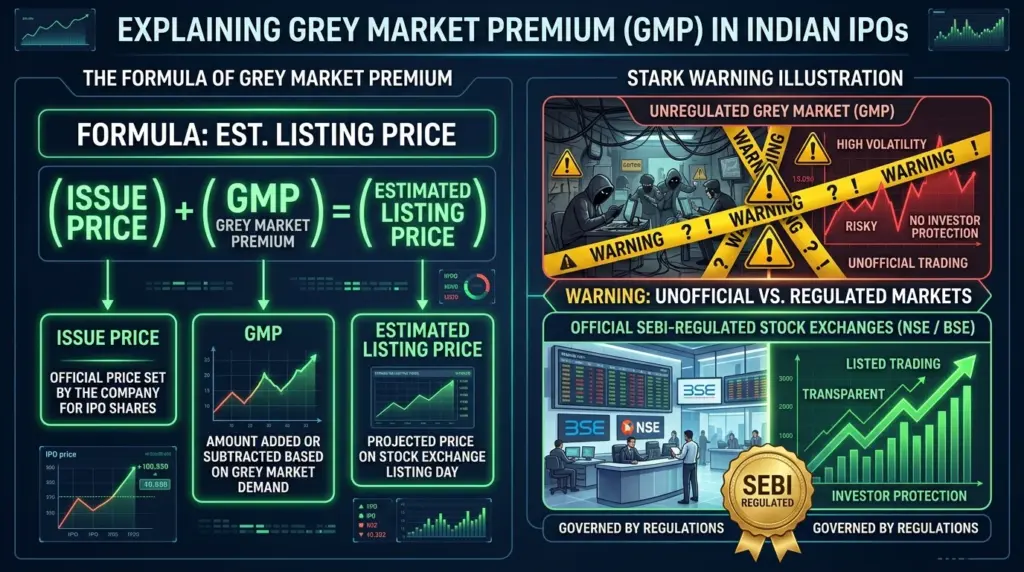
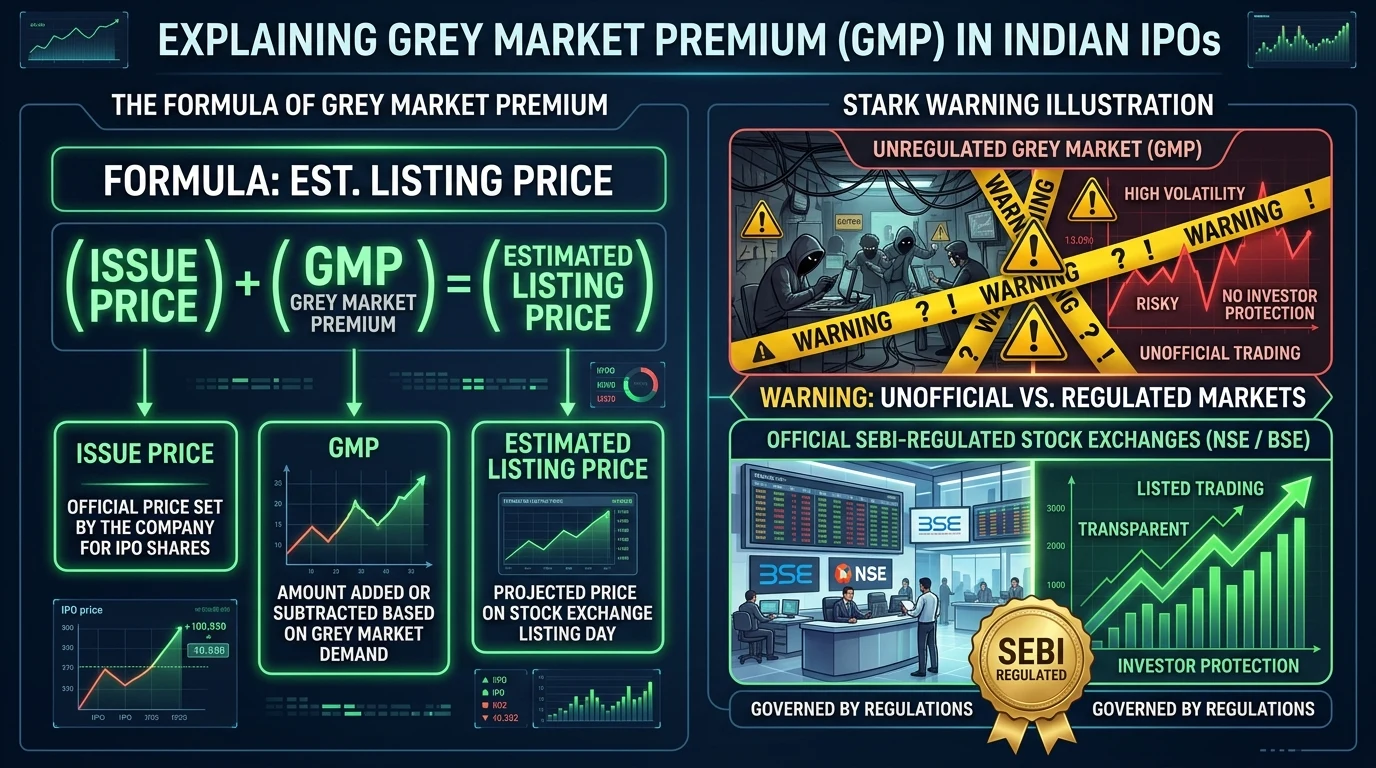
Before risking your hard-earned capital, you must understand the exact definition: Grey Market Premium (GMP) is the unofficial price premium at which unlisted shares of an upcoming IPO are traded in an unregulated, over-the-counter (OTC) cash market before their official debut on recognized stock exchanges like the NSE and BSE.
In simple terms, if a company prices its IPO shares at ₹200 per share and the prevailing grey market quote is ₹80, traders in this shadow market are willing to buy those shares unofficially for ₹280. This difference of ₹80 is the Grey Market Premium.
While beginners often treat GMP as a definitive scientific gauge of a company's financial worth, experienced market veterans recognize it for what it truly is: an informal, highly speculative sentiment indicator operating in a micro-liquidity environment without regulatory oversight. To build a durable wealth creation plan, one must master the foundational principles of investing in stock market rather than relying on shadow-market whispers.
2. Legal & Regulatory Reality: What SEBI Says About Grey Market Trading
A common misconception among retail investors is that grey market transactions are formally recognized or safeguarded by market regulators. Nothing could be further from the truth.
Statutory Warning: Grey Market is Strictly Illegal and Unenforceable
The Securities and Exchange Board of India (SEBI) does not recognize, regulate, or permit grey market transactions in any capacity. There is no clearing corporation (such as NSE Clearing Ltd or ICCL) to guarantee settlement. If your counterparty defaults, takes your money, or refuses to deliver promised shares after listing, you have zero legal recourse. Neither SEBI, nor the consumer courts, nor the stock exchanges will entertain your complaint.
Grey market operations thrive purely on informal networks—local brokers, regional bookies, and unvetted WhatsApp groups. Settlements occur entirely in cash or unrecorded bank transfers under mutual trust. When the market turns hostile, counterparty default rates spike dramatically, leaving retail participants holding worthless verbal contracts.
3. How is IPO GMP Calculated? Real Mathematical Examples
Understanding the mathematical mechanics of GMP is straightforward, but interpreting what those numbers actually represent is where retail investors stumble. The standard formulas used across unofficial market trackers are:
Estimated Listing Price = Issue Price (Cap Price) + Grey Market Premium (GMP)
Expected Percentage Listing Gain (%) = (GMP / Issue Price) × 100
Expected Total Gain per Lot (₹) = GMP (₹) × Number of Shares in One Retail Lot
Case Study A: Premium / Bullish GMP Scenario
Let us examine an upcoming tech manufacturing company coming out with an IPO:
- IPO Price Band: ₹475 – ₹500 per share (Issue Price = ₹500)
- Minimum Retail Lot Size: 30 shares (Total investment = ₹15,000)
- Current Grey Market Premium (GMP): ₹250 per share
Using the formulas above:
- Estimated Listing Price: ₹500 + ₹250 = ₹750 per share
- Expected Listing Gain (%): (₹250 / ₹500) × 100 = +50.0%
- Expected Profit per Lot: ₹250 × 30 shares = ₹7,500 per allotted lot
Case Study B: Discount / Negative GMP Scenario
Now consider a capital-intensive infrastructure firm facing heavy debt and aggressive valuations:
- Issue Price: ₹800 per share
- Lot Size: 18 shares (Investment = ₹14,400)
- Current Grey Market Quote: -₹80 (Discount of ₹80 per share)
The calculations reveal:
- Estimated Listing Price: ₹800 + (-₹80) = ₹720 per share
- Expected Listing Discount (%): (-₹80 / ₹800) × 100 = -10.0%
- Expected Loss per Lot: -₹80 × 18 shares = -₹1,440 per lot
While the math appears simple, retail investors often make the fatal error of believing that GMP is a binding financial contract. In reality, GMP fluctuates violently minute by minute based on prevailing market mood, institutional subscription figures, and synthetic operator trades.
4. The 5-Stage Operator Manipulation Trap Exposed
Why does an IPO with an 80% GMP frequently list flat or plummet 25% on listing day? The answer lies in the structural mechanics of market manipulation. Because the grey market is thinly traded, syndicated operators exploit it as an ultra-cheap marketing megaphone.
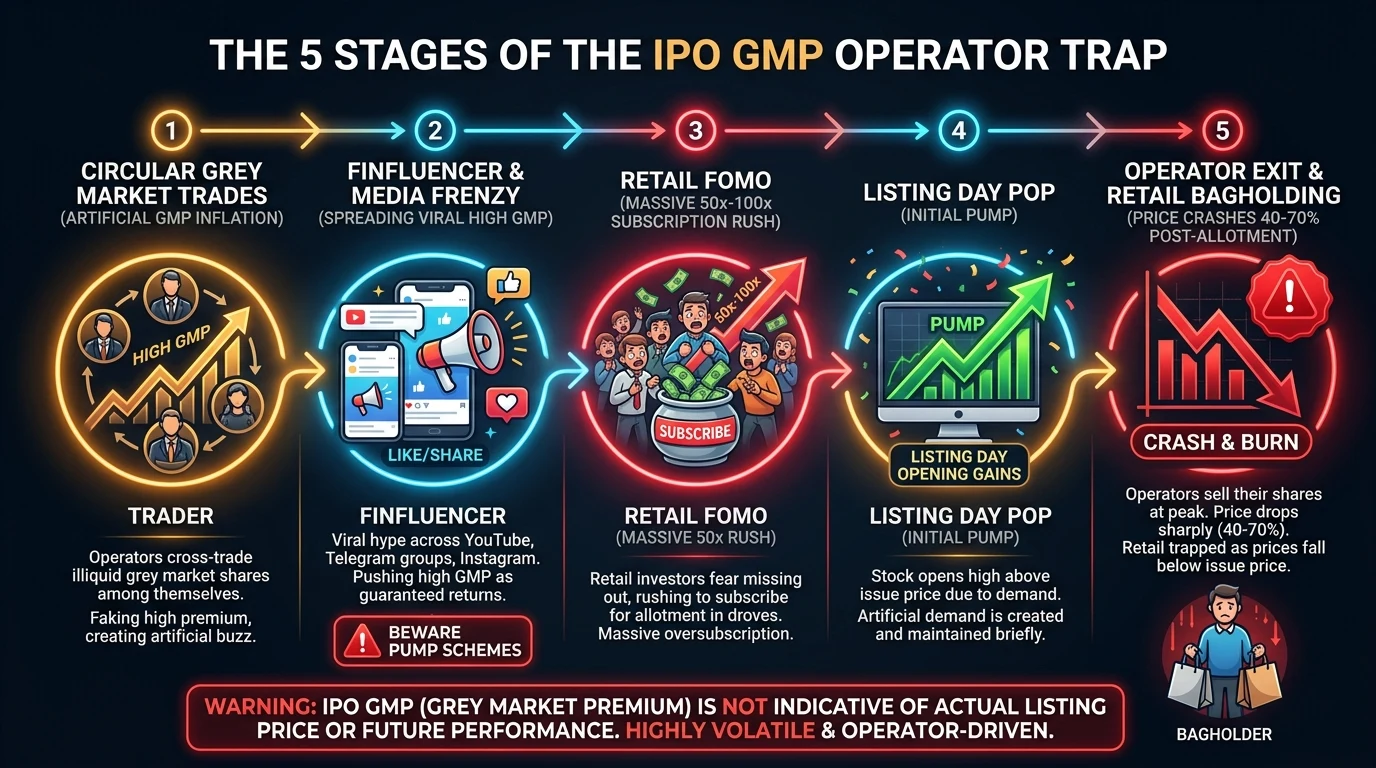
Let us pull back the curtain on how this 5-stage trap unfolds in the Indian equity landscape:
Stage 1: Circular Grey Market Trades (Artificial Price Painting)
A consortium of operators or unlisted brokers agrees to trade a minuscule quantity of unlisted shares (say, 500 to 2,000 shares) among themselves at an artificially inflated price. Because there is no exchange order book, a single operator selling to their own partner at +₹150 premium instantly sets the "official" GMP quote reported by regional brokers.
Stage 2: Finfluencer Amplification & Social Hype
The fabricated GMP is blasted across Telegram IPO channels, Instagram reels, and YouTube live streams. Finfluencers—often sponsored or simply hungry for viral clicks—broadcast headlines like "Crazy 90% GMP! Do Not Miss This Multibagger IPO!" The dark reality behind these social media pump tactics is documented in our investigative report on the finfluencer frenzy and stock market controversies.
Stage 3: Mass Retail FOMO & 100x Oversubscription
Fearing that they will miss out on easy listing gains, millions of retail investors apply using multiple family Demat accounts. Non-Institutional Investors (NII / HNI) borrow money from NBFCs at 10%–14% annualized rates to bid 50x to 100x their net worth. This massive subscription data is then weaponized to validate the fake GMP!
Stage 4: Listing Day Pop or Panic Gap-Down
On listing day at 10:00 AM, one of two things happens: either the stock opens high for the first 15 minutes due to pent-up pre-open buy orders, or the operators quietly withdraw their bids before 9:45 AM, causing the stock to open at a steep discount to the hyped GMP.
Stage 5: Institutional Exit & Retail Bagholding
Pre-IPO investors, private equity funds, and early promoters use the initial liquidity surge to dump their massive holdings onto unsuspecting retail buyers. As the stock steadily drifts lower over the next 3 to 12 months, retail investors are left holding the bag at peak valuations, nursing 40% to 70% capital destruction.
5. The 3 Pillars of Grey Market: GMP vs Kostak Rate vs Subject to Sauda
In informal IPO market parlance, you will encounter three distinct financial terms: Grey Market Premium (GMP), Kostak Rate, and Subject to Sauda. Mixing these up is a common rookie error.
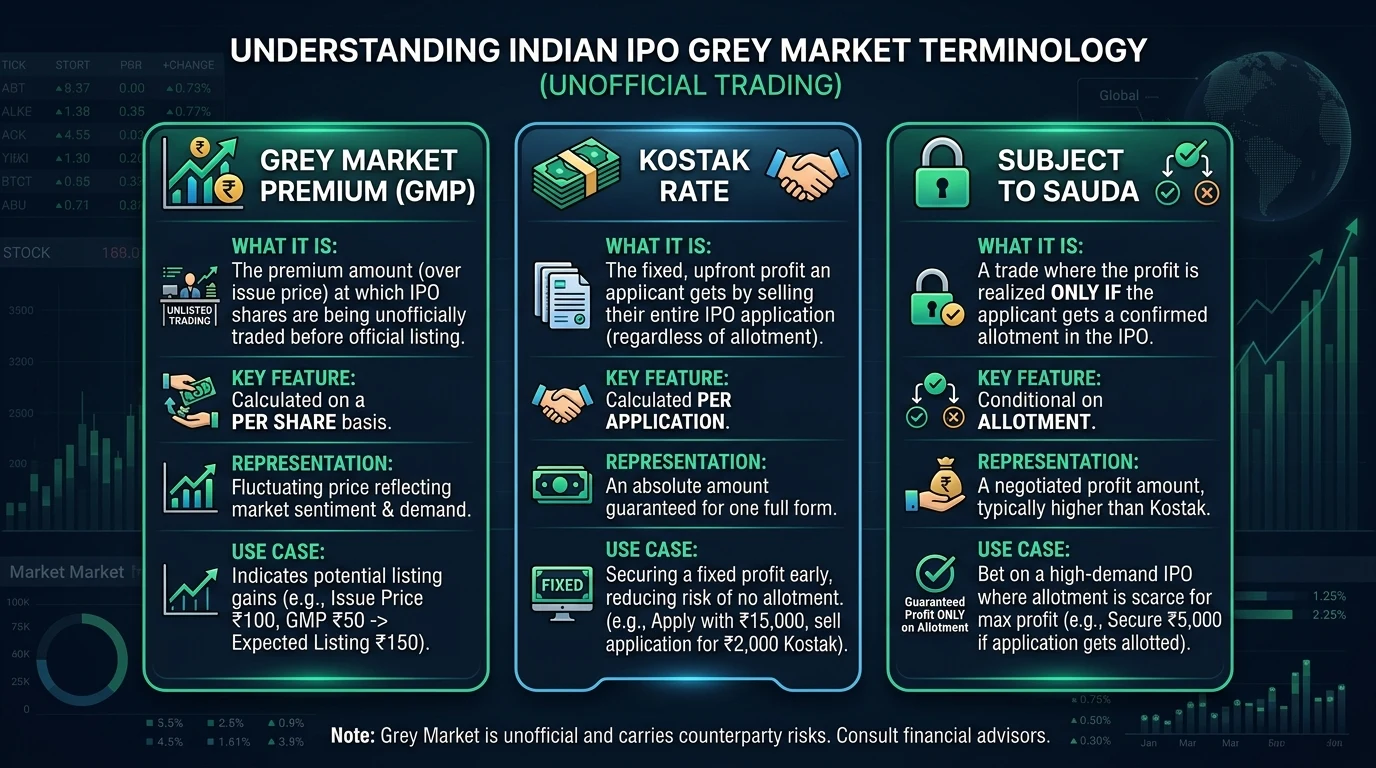
Here is an institutional-grade breakdown of each instrument's mechanics, risk profile, and settlement structure:
| Feature / Parameter | Grey Market Premium (GMP) | Kostak Rate | Subject to Sauda |
|---|---|---|---|
| Basic Definition | The unofficial premium per individual share over the IPO issue price. | The fixed upfront profit paid to an applicant for selling their entire application form. | A conditional contract where profit is paid ONLY IF the applicant gets allotted shares. |
| Calculation Unit | Per Share (e.g., ₹150/share) | Per Application Form (e.g., ₹1,200/form) | Per Allotted Lot (e.g., ₹6,000/allotted lot) |
| Allotment Dependence | Directly dependent on allotment; profit realized upon selling allotted shares. | Independent of allotment. The applicant keeps the Kostak cash even if allotment fails! | Strictly conditional. If no allotment is received, the contract becomes completely void (₹0). |
| Risk to the Seller (Applicant) | Market price volatility risk on listing day. | Opportunity loss if the stock lists at a massive premium exceeding the Kostak amount. | Zero capital risk, but bounded upside. |
| Risk to the Buyer (Operator) | Risk that listing price falls below issue price + GMP paid. | High risk of capital loss if the application does not get allotted shares in the lottery. | Risk that the stock opens below the agreed Subject to Sauda price. |
| SEBI / Legal Status | Completely Unregulated / Illegal | Completely Unregulated / Illegal | Completely Unregulated / Illegal |
Prasad Sogi's Practical Example:
Suppose you apply for an IPO with a lot value of ₹15,000. If the Kostak rate is ₹1,500, an operator pays you ₹1,500 in cash today for your application. If you get zero shares allotted, you still keep that ₹1,500. If you do get allotted shares, you must transfer those shares to the operator on listing day, and the operator takes 100% of the listing gains. Conversely, under Subject to Sauda at ₹5,000, you only receive ₹5,000 if you actually win the allotment lottery; if you don't get allotted, nobody pays anyone anything.
6. Why Does the Grey Market Exist in India?
Given that it carries high counterparty risk and zero legal backing, why has the grey market flourished in Indian financial hubs like Rajkot, Ahmedabad, Jaipur, and Mumbai for decades? The phenomenon is driven by three powerful market forces:
- The Allotment Timeline Lag: In India, the period between the IPO bidding window closing and official listing on exchanges used to span 6 to 12 days (now compressed to T+3 business days by SEBI). During this window, institutional and retail sentiment changes based on global cues, news flows, and anchor allocations. Speculators want to hedge or monetize their exposure before official listing.
- Scarcity & Lottery Hedging: In a massively oversubscribed IPO (e.g., 80x retail subscription), the probability of an individual winning an allotment is less than 1.5%. HNI syndicates and retail applicants use the Kostak market to lock in a small, guaranteed cash return rather than relying on pure lottery luck.
- Synthetic Leverage by HNIs: High-net-worth individuals who cannot secure sufficient allocation through the formal retail window use the grey market to accumulate large blocks of shares from hundreds of retail applicants before trading commences on the exchange.
- The Psychological Illusion of Insider Knowledge: Humans love the feeling of having "insider" or "early access" information. Seeing a private, unlisted quote makes retail traders feel like they possess an edge over the broader public, blinding them to the reality that they are trading in an illiquid, operator-controlled fishbowl.
7. Historical Reality Check: Famous Indian IPO Traps Where GMP Failed Completely
If GMP were truly an accurate predictor of stock market returns, following it would make every retail investor wealthy. In reality, some of the most catastrophic wealth destruction events in Dalal Street history were preceded by buoyant grey market sentiment.
| Company Name | Issue Price (₹) | Peak Hyped GMP | Expected Listing (₹) | Actual Listing Price (₹) | Day 1 Return vs GMP | 1-Year Return After Listing |
|---|---|---|---|---|---|---|
| Paytm (One97 Comm.) | ₹2,150 | +₹150 to +₹200 | ₹2,300 – ₹2,350 | ₹1,955 | -27.2% Crash | -65.0% Wealth Destruction |
| Life Insurance Corp (LIC) | ₹949 | +₹85 to +₹100 | ₹1,034 – ₹1,049 | ₹867 | -8.6% Discount | -35.0% Prolonged Bear Phase |
| Reliance Power (2008) | ₹450 | +₹400 to +₹500 (+100%) | ₹900 – ₹950 | ₹547 (Peaked at ₹600) | Crashed below ₹400 in 15 mins | -80.0% Systemic Collapse |
| Zomato Ltd (2021) | ₹76 | +₹25 (+33%) | ₹101 | ₹115 (Initial Pop) | +51.3% Pop | Crashed to ₹40 (-65% from peak) |
| Delhivery Ltd | ₹487 | +₹15 to +₹25 | ₹502 – ₹512 | ₹495 | +1.6% Flat | Crashed to ₹310 (-36%) |
The Anatomy of the Paytm Disaster
In November 2021, One97 Communications launched India's largest-ever IPO at ₹2,150 per share, seeking an astronomical valuation of over ₹1.4 lakh crore despite generating massive quarterly cash burn. Prior to the subscription window, grey market chatter claimed a positive GMP of ₹150–₹200. Retail and HNI investors jumped in.
On listing day, institutional bids vanished. Paytm opened at ₹1,955 and plunged by its 20% lower circuit limit to close at ₹1,564 on Day 1. Within 12 months, the stock plummeted to under ₹500, destroying over ₹1 lakh crore in investor wealth. Those who applied based on GMP lost more than half their capital, while those who scrutinized fundamental balance-sheet cash flows walked away unscathed.
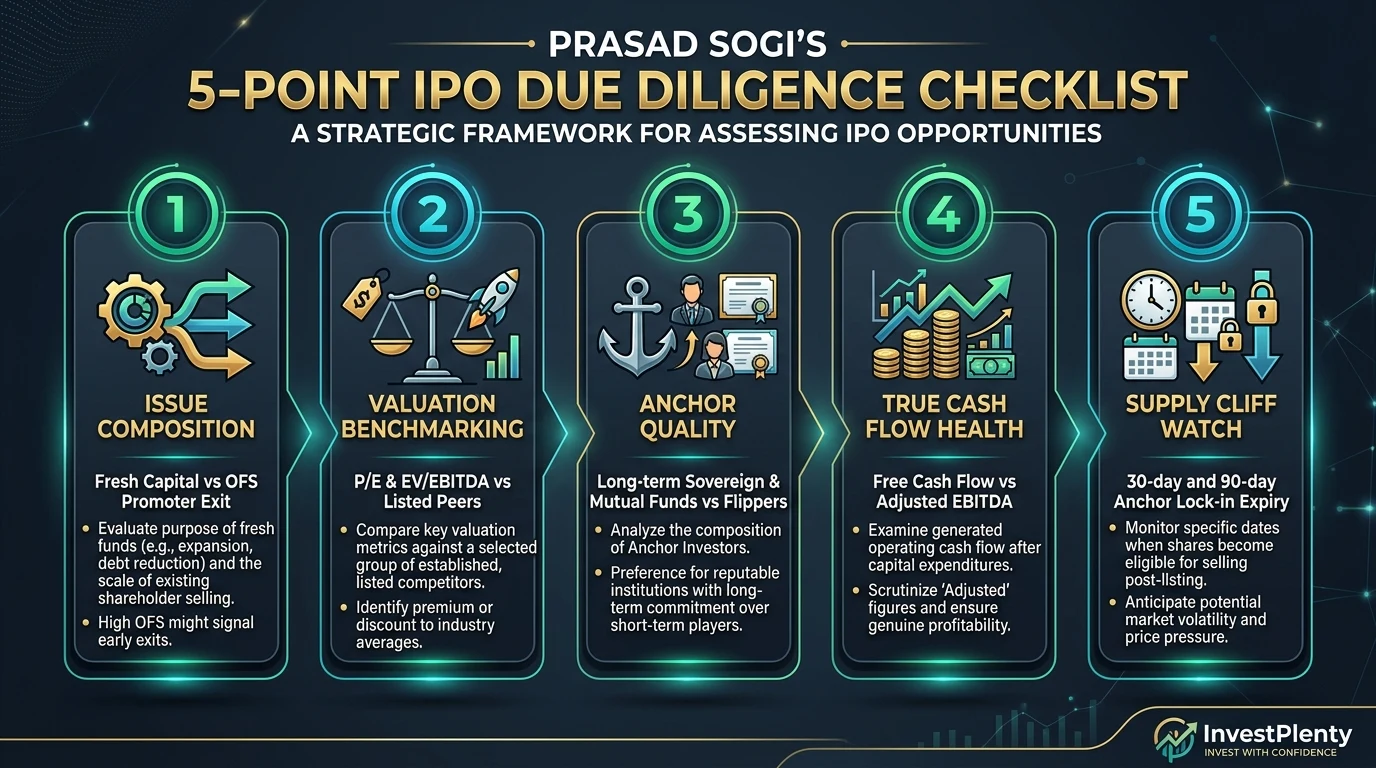
8. Prasad Sogi's 5-Point IPO Due Diligence Framework
Instead of gambling on unverified grey market chatter, disciplined wealth builders evaluate IPOs using an engineering-driven, evidence-based fundamental framework. When analyzing any Red Herring Prospectus (RHP), you must subject the offering to these five non-negotiable checks:
1. Issue Composition: Fresh Issue vs Offer for Sale (OFS)
Always check where your money is actually going. A Fresh Issue injects capital directly into the company's balance sheet to pay down debt, build manufacturing plants, or fund R&D. Conversely, an Offer for Sale (OFS) means the money goes entirely into the personal pockets of promoters and early private equity venture capitalists who are dumping their shares onto public markets.
Rule of Thumb: Be extremely skeptical of any IPO where OFS exceeds 70% of the total issue size, particularly if early PE investors are exiting 100% of their stake at peak valuations.
2. Valuation Benchmarking Against Established Listed Peers
Investment bankers price IPOs to maximize promoter proceeds, not to leave money on the table for retail buyers. Compare the company's Price-to-Earnings (P/E), EV/EBITDA, and Price-to-Sales (P/S) multiples directly against established listed competitors with proven track records.
If an unproven debutant demands an 85x P/E when an industry titan like Tata Consultancy Services or Larsen & Toubro trades at 28x P/E with superior margins, you are paying a massive vanity premium that guarantees long-term underperformance.
3. Anchor Investor Quality & Pedigree
Before an IPO opens to the public, institutional anchor investors are allocated shares. Review the anchor allotment list published on stock exchange websites. Look for long-term sovereign wealth funds (e.g., GIC Singapore, Abu Dhabi Investment Authority) and respected domestic mutual fund houses (e.g., SBI MF, HDFC MF, Nippon Life). If the anchor book is dominated by obscure offshore hedge funds or proprietary trading desks, it signals a flipper-dominated book that will exit at the earliest opportunity.
4. True Cash Flow Health vs "Adjusted EBITDA" Acrobatics
New-age companies love inventing synthetic accounting metrics: "Adjusted EBITDA", "Contribution Margin 1", or "EBITDA before Employee Stock Option Costs". Ignore these PR gimmicks. Turn directly to the Cash Flow Statement in the RHP. Is the company generating positive Cash Flow from Operations (CFO)? Can it fund its capital expenditures from internal accruals, or does it require continuous public bailouts to survive?
5. Supply Cliff Watch: 30-Day & 90-Day Lock-in Expiries
Under SEBI regulations, 50% of the anchor investor allocation is locked in for 30 days, while the remaining 50% is locked in for 90 days. Pre-IPO shareholders face a 6-month or 1-year lock-in. Track these calendar dates diligently. When lock-in restrictions expire, an avalanche of supply frequently hits the order book, creating severe downward price shocks.
1-on-1 IPO & Portfolio Risk Audit with Prasad Sogi
Confidential • Data-Driven • Engineered for Senior Corporate Executives & HNIsAre you considering deploying significant capital (₹10 Lakh to ₹1 Crore+) into upcoming mega-IPOs or unlisted pre-IPO shares? Don't rely on Telegram tipsters or broker sales quotas. In an exclusive 1-on-1 strategic portfolio audit, Prasad Sogi personally reviews:
Deep-dive into promoter holding, related-party transactions, debt repayment clauses, and litigation disclosures that retail research reports leave out.
Balancing your overall equity portfolio with non-cyclical mutual funds and debt instruments so speculative market events never jeopardize your family's financial freedom.
10. Frequently Asked Questions (FAQ)

About the Author: Prasad Sogi
Founder & Chief StrategistPrasad Sogi is the Founder of InvestPlenty and an AMFI-registered Mutual Fund Distributor (ARN: 159978). Prior to dedicating himself full-time to wealth advisory and investor education, Prasad built a distinguished 13+ year career as an Enterprise Software Engineer and Technology Lead at global tech giants IBM and Hewlett Packard (HP).
Actively navigating Indian equity and derivatives markets since 2007, Prasad combines rigorous engineering logic with disciplined fundamental valuation principles. He specializes in debunking speculative finfluencer myths, guiding senior executives, business leaders, and retail investors toward sustainable, risk-adjusted long-term wealth compounding.